
Wolford v. Lopez Decision Strengthens the Self-Defense Rights of Peace Officers
DAVID E. MASTAGNI
Partner
Mastagni Holstedt, APC
TIMOTHY K. TALBOT
Principal
Rains Lucia Stern St. Phalle & Silver, PC
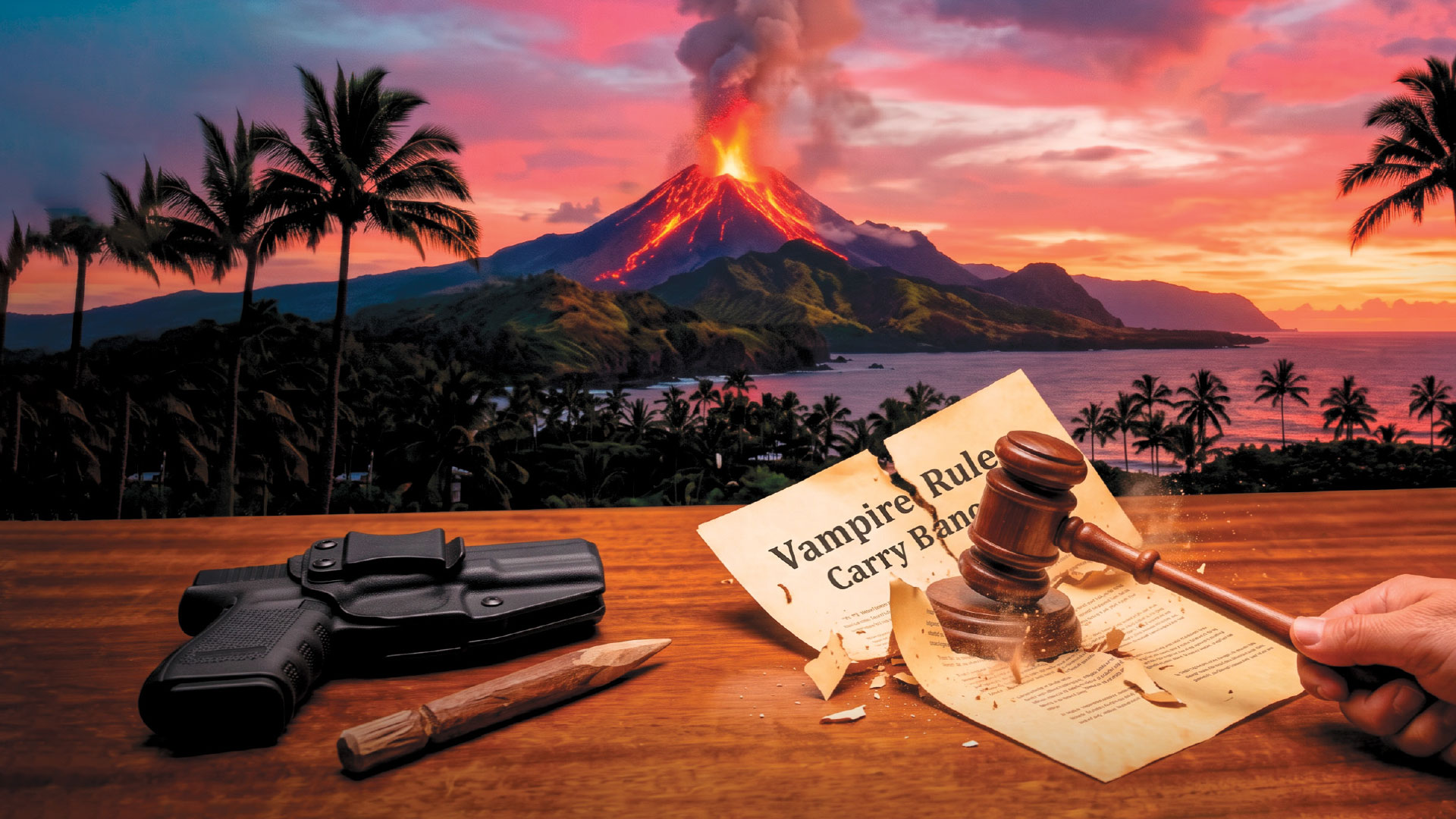
The U.S. Supreme Court has reaffirmed that the Second Amendment protects the right to carry a firearm for self-defense throughout the ordinary course of daily life. In Wolford v. Lopez, 609 U.S. ___ (2026), the court, by a vote of six to three in an opinion authored by Justice Alito and joined by Chief Justice Roberts and Justices Thomas, Gorsuch, Kavanaugh and Barrett, struck down a Hawaii statute that made it unlawful for licensed concealed carry holders to possess their weapons on private property open to the public absent the owner’s express consent. (This is commonly known as the “vampire rule” because mythical vampires cannot enter a premises without an express invitation.) The court held that such a law imposes an unconstitutional burden on the right to bear arms.
Our firms filed an amicus curiae brief with the Supreme Court on behalf of PORAC, the California Association of Highway Patrolmen (CAHP) and the Crime Prevention Research Center (CPRC), urging the court to reverse the Ninth Circuit. That brief supplied empirical support for the position the court ultimately adopted. It demonstrated that sensitive-place regimes and default-prohibition rules of the kind Hawaii enacted do not enhance public safety, that the studies purporting to validate them suffer from serious methodological defects because they fail to account for differences among permitting regimes and that laws expanding the right to carry have not increased violent crime. We advanced the same arguments on behalf of PORAC, CAHP and CPRC in a separate amicus brief filed in the Ninth Circuit in support of challenges to California’s own version of the same restrictions (May v. Bonta, 709 F. Supp. 3d 940 [C.D. Cal. 2023]). The Court of Appeals resolved the Bonta case alongside the Hawaii litigation.
For the peace officers of California, both active and retired, the decision accomplishes far more than protecting the rights of ordinary citizens who carry. It establishes a constitutional floor for the right of self-defense and equips officers to challenge the restrictive statutes and policies that have long constrained their ability to protect themselves, their families and the public. The Wolford decision also forecloses any effort by California to enact its own version of the “vampire rule.” Had the Supreme Court upheld Hawaii’s approach, California could have cured the defects in its own restrictions simply by copying the Hawaii model. By rejecting that model outright, Wolford eliminates the workaround and denies California a template for reviving its most aggressive limitations on where permit holders may lawfully carry.
The Court’s Holding
Hawaii inverted the longstanding common law presumption that governs entry onto property open to the public. At common law, a proprietor welcomed every member of the public, including those who were armed, unless the owner affirmatively withdrew that welcome. Hawaii flipped that presumption for anyone carrying a firearm by forbidding entry unless the owner expressly granted permission (Wolford, supra, at 1). The court held that this statute, which bars licensed permit holders from carrying handguns on private property open to the public without the owner’s express consent, violates the Second and Fourteenth Amendments (Id. at 6). The court reversed the Ninth Circuit and remanded for further proceedings consistent with its opinion (Id. at 28). Because the Ninth Circuit has spent years narrowing the right to bear arms through a succession of grudging decisions, the significance of that reversal is difficult to overstate.
The majority grounded its analysis in the framework announced by the court in New York State Rifle & Pistol Ass’n v. Bruen, 597 U.S. 1 (2022). Under that framework, a court asks first whether the plain text of the Second Amendment covers the conduct at issue, and the Wolford majority readily concluded that it does. Carrying a handgun for self-defense is precisely the conduct the amendment protects, and the licensed permit holders who wish to do so are precisely the people the amendment protects (Wolford, supra, at 17). That conclusion placed the burden squarely on Hawaii to justify its statute through the nation’s history and tradition of firearm regulation.
The court then explained why Hawaii’s statute imposes a new and substantial burden on the exercise of the right. The common law default permitted any member of the public to enter property open to the public unless the owner expressly forbade it, and Hawaii reversed that default for armed citizens by prohibiting entry unless the owner expressly allowed it. By transforming a presumption of welcome into a presumption of exclusion, and by doing so only for those exercising a constitutional right, Hawaii created a modern burden unsupported by history. The court concluded that the statute severely hampers the ability of law-abiding citizens to exercise the right recognized in Bruen. That conclusion establishes that a state may not smother the carry right through a default rule dressed up as a property regulation.
Why Hawaii’s Historical Case Failed
Hawaii could prevail only by identifying a genuine historical tradition of comparable regulation, so it assembled a collection of old statutes and asked the court to treat them as analogues. The court found the collection wanting at every turn. It first reaffirmed that the Second Amendment carries the same meaning in every part of the country and does not yield to the spirit of aloha any more than it yields to local attitudes anywhere else (Id. at 3). The colonial statutes Hawaii invoked addressed poaching, a wholly different problem approached in a wholly different manner, and bore no meaningful resemblance to a sweeping prohibition on carrying firearms in the commercial spaces residents visit every day (Id.). An 1893 Oregon statute fared no better, both because the record left it unclear whether that law even reached property open to the public and because a solitary statute enacted nearly a century after the Second Amendment, and well after the Fourteenth, reveals almost nothing about the original understanding of the right (Id.).
The most arresting passage of the court’s opinion confronted Hawaii’s reliance on an 1865 Louisiana statute that made it unlawful to carry firearms on another person’s premises without the owner’s consent (Id. at 27). That statute formed part of Louisiana’s Black Code, one of the notorious enactments adopted by the defeated Confederate States to keep newly freed Black Americans subjugated and defenseless. The court refused to treat that enactment as evidence of the nation’s constitutional tradition. Drawing on McDonald v. City of Chicago, 561 U.S. 742 (2010), the majority reminded the country that the framers of the Fourteenth Amendment understood the right to keep and bear arms as a vital protection for vulnerable Black citizens in the postwar South, who needed firearms to defend themselves when no one else would. The court declared that, unless we put history entirely out of our minds, Hawaii’s claim that this tainted artifact illuminates the original understanding of the right to keep and bear arms cannot be taken seriously.
That passage confirms that the historical inquiry required by Bruen is a serious and disciplined undertaking, rather than an exercise in which a state may pull any statute from the shelf and rebrand it as tradition. It instructs lower courts, which have too often resisted Bruen, that they must apply the framework with rigor. The message reaches every jurisdiction that has attempted to evade the Second Amendment through creative historical revisionism.

What the Decision Means for California’s Peace Officers
Wolford arose in Hawaii, yet its consequences travel directly into California. For years, California has defended restrictions on where permit holders may carry that reach so widely that critics fairly describe them as draining the permit of its value in the very places where people most need protection. By reversing the Ninth Circuit and rejecting the historical justifications for laws of this kind, the Supreme Court has foreclosed California’s ability to preserve its own regime by conforming it to a model that the court has now condemned. The state can no longer point to Hawaii’s approach as a safe harbor, and that development benefits every officer who carries.
The benefits for law enforcement extend well beyond the commercial carry setting in which the case arose. Wolford reaffirms a constitutional minimum for concealed carry, a floor below which no state may push permit holders, whether they carry on duty or off. Officers do not shed the dangers of their profession when a shift ends, because the people they arrest recognize them in restaurants, at gas stations and in grocery stores, and the threats they accumulate follow them into private life. A rule that converts every unmarked private business into a prohibited zone falls hardest on those who most need to remain armed as they move through public spaces, and officers occupy that category as surely as any crime victim does. By holding that the right to carry for self-defense accompanies the individual into the ordinary places of daily life, the court secured for officers and the families who share their exposure a baseline of protection that restrictive state laws can no longer quietly erode.
How Wolford Undercuts Mahoney and Revives Officer Self-Defense Rights Under the Second Amendment
The decision delivers a further benefit to those in law enforcement by undermining the reasoning that Ninth Circuit precedent long used to dismiss officers’ self-defense claims. In Mahoney v. Sessions, 871 F.3d 873 (9th Cir. 2017), a group of Seattle officers challenged their department’s use-of-force policy, and the Court of Appeals rejected their self-defense arguments, reasoning that current case law does not support the existence of a freestanding fundamental right to self-defense outside of the right of law-abiding, responsible citizens to use arms in defense of hearth and home (Id.). Relying on that constricted understanding of the Second Amendment, the court applied intermediate scrutiny through the government-as-employer doctrine and treated the department’s control over its issued weapons as a reason to demand far less constitutional justification. The court accordingly held that the policy survived intermediate scrutiny and passed constitutional muster. The Seattle policy at issue resembled early versions of the California use-of-force measures that the Legislature later advanced as Assembly Bill 931 and Assembly Bill 392.
Wolford decisively rejects that analysis. By reaffirming that the Second Amendment protects the carrying of arms for self-defense as law-abiding citizens move through public spaces and private property open to the public, the Supreme Court undercut the premises on which Mahoney rested (Wolford, supra, at 6). The court confirmed that restrictions of this kind must satisfy a rigorous history-and-tradition test rather than the deferential balancing approach employed by the Ninth Circuit (Id. at 2). Officers who challenge restrictive California statutes that burden their right to bear arms for protection, on duty and off, now stand on markedly stronger constitutional ground. The freestanding right-framing that Mahoney used to brush aside those claims will prove far harder to sustain. In the context of an officer-involved shooting, where governments routinely defend use-of-force statutes and departmental policies as mere employer regulations subject to watered-down scrutiny, Wolford provides officers a powerful response by recognizing the right to defend oneself with a firearm as a core constitutional guarantee, not a privilege the government may balance away merely because it happens to be the employer.
What the Decision Means for Retired Officers
The ruling sets an equally important floor for retired officers, who must confront the lingering dangers of a career spent in public safety. The enemies an officer accumulates through decades of service do not retire when the officer turns in a badge, and the risk of a targeted encounter persists for years. Wolford confirms that the constitutional right to carry for self-defense accompanies retirees into the everyday spaces of civilian life and forecloses the default-prohibition regime that would otherwise strip away that protection in the very places retirees, like everyone else, must visit (Id. at 6). Retirees therefore gain a durable guarantee that no state may quietly disarm them.
Continuing Defense of the Right to Self-Defense
Wolford is not an endpoint in Second Amendment jurisprudence. PORAC will continue to pursue Second Amendment appeals that protect the rights of its members and all Californians. PORAC litigates these cases to secure the right of self-defense because a rule that disarms ordinary citizens endangers the public that peace officers serve as surely as it endangers officers themselves.
That commitment appears most clearly in the ongoing challenge to California’s Unsafe Handgun Act. In Boland v. Bonta, 662 F. Supp.3d 1077 (C.D. Cal. 2023), the district court examined the act’s requirement that every new handgun sold in the state include a chamber load indicator, a magazine disconnect mechanism and microstamping capability, even though almost no handguns contain all three features. The court held that the plain text of the Second Amendment protects the purchase of modern handguns and that the state’s roster requirements do not comport with the nation’s historical tradition of firearm regulation. It therefore enjoined their enforcement.
The practical consequences are significant. Prior to our involvement in the Boland lawsuit, the microstamping requirement had blocked the approval of any new semiautomatic handgun for sale in California since 2013 and forced residents to rely for self-defense on models that reached the market more than a decade ago. The Legislature also introduced legislation, which PORAC temporarily killed, that would have eliminated the exemption allowing officers to purchase off-roster guns. Boland remains in active litigation, and PORAC has filed an amicus brief in the Ninth Circuit. Its resolution will determine whether California officers retain their right to own off-roster handguns.
The stakes in that litigation have grown because the Supreme Court has now agreed to hear a challenge to a state prohibition on commonly owned semiautomatic firearms. When the court applies the history-and-tradition framework to a direct ban on the arms themselves, it will sharpen the analysis that governs California’s roster restrictions and the broader question of which modern firearms are protected by the Second Amendment. A decision confirming that commonly owned firearms fall within the constitutional text would fortify our position in Boland and intensify the constitutional pressure on the Unsafe Handgun Act. It would establish that California may not condition the exercise of the right on features that no manufacturer can supply.
The Road Ahead
The lasting importance of Wolford lies in the uniform national standard that it reinforces. The Second Amendment carries the same meaning in Honolulu, Sacramento and every community between them, and the history-and-tradition test governing its application will now operate with discipline rather than evasion. Restrictive-carry regimes that profess respect for the right while quietly disarming permit holders in spaces the public routinely enters now rest on far weaker ground.
Litigation will continue, particularly within the Ninth Circuit, and important questions remain open. Yet the court has drawn a clear line in favor of law-abiding citizens, sworn officers and retirees who wish only to protect themselves and their families.
About the Authors
David E. Mastagni is a partner with the law firm of Mastagni Holstedt, APC, and an experienced panel attorney for the PORAC Legal Defense Fund. He also provides legal analysis and representation for PORAC at the California Legislature on bills affecting public safety employees.
Timothy K. Talbot is a principal at Rains Lucia Stern St. Phalle & Silver, PC, and manages the firm’s Sacramento office. He is a member of the Collective Bargaining Practice Group and manages the Labor Litigation Group, where he oversees the firm’s representation of public and private sector employee associations and individual clients in litigation.